
 中文
中文
-
Shipping Containers
- Container Parts
- Roof Panel
- Side Panel
- Front End Panel
- Door Panel
- Front Corner Post
- Rear Corner Post (Outer/Inner)
- Cross Member
- Bottom Side Rail
- Top Side Rail
- Door Sill
- Front Bottom Rail
- Top End Rail
- Door Header Upper/Lower
- Door Rail
- Floor Spacer
- Angle
- Top/Bottom End Rail
- Door Edge Member
- Door Sealing
- Door Frame Profile
- Door Lining
- Door Hardwares
- Door Gasket
- Side Panel/Lining
- T-Floor
- Roof Panel/Lining
- Cross Member
- Bottom Side Rail
- Top Side Rail
- Ledge PVC
- Kazoo Drain
- Auto Drain
- Alu Tube
- Auto Drain Center Part
- PVC Drain Pipe
- PVC Plugs f. Drain with Ring and Steel Wire
- Door Screw
- Door Screw Nut
- Door Screw Rubber
- Tapping Screw
- Stainless Blind Rivet
- Lashing Ring
- CSC Plate
- Welding Wire
- Tapping Screw Bit
- Vehicle Parts
- Ship Supplies
- 00. Provisions
- 11. Welfare Items
- 15. Cloth & Linen Products
- 17. Tableware & Galley Utensils
- 19. Clothing
- 21. Rope & Hawsers
- 23. Rigging Equipment & General Deck Items
- 27. Painting Equipment
- 31. Safety Protective Gear
- 33. Safety Equipment
- 35. Hose & Couplings
- 37. Nautical Equipment
- 39. Medicine
- 45. Petroleum Products
- 47. Stationery
- 49. Hardware
- 51. Brushes & Mats
- 55. Cleaning Material & Chemicals
- 59. Pneumatic & Electrical Tools
- 61. Hand Tools
- 63. Cutting Tools
- 65. Measuring Tools
- 69. Screws & Nuts
- 75. Valves & Cocks
- 77. Bearings
- 79. Electrical Equipment
- 81. Packing & Jointing
- 85. Welding Equipment
- 87. Machinery Equipment
- Vehicles
- Lashing Tools
- Logistics Tools
BlogContainer Use & Repair GuidelinesMay 09,2026During global container operation and turnover, damage is almost inevitable and will directly affect normal liner service. For cost control, correct container usage to minimize damage and timely repair to quickly restore service are the two core points of container management.
This article systematically explains container damage classification, correct usage rules, daily maintenance, and repair standards to help you extend container life and reduce operating costs.
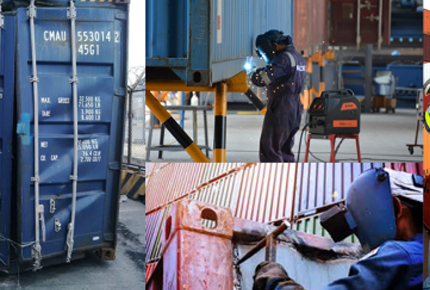
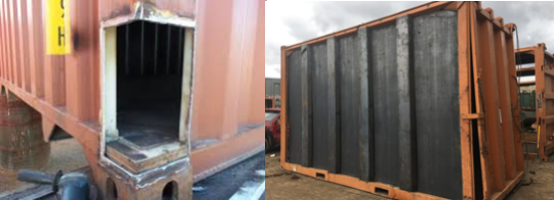
1. Two Main Types of Container Damage
① Abnormal Damage
Caused by external impact, improper operation, or cargo factors:
• Collision, truck accidents, lifting drops
• Improper loading/unloading
• Overweight, unbalanced loading, sharp cargo scratches
• Leakage, pollution from liquid/dusty goods
• Damage to reefer units due to wrong operation
This type of damage is preventable and accounts for most repair costs.
② Natural Damage
Normal wear during long-term use:
• Body rust, paint aging
• Floor aging, delamination
• Minor scratches not affecting cargo safety
• Natural wear of labels, seals, and small components
• Normal aging of reefer parts
This type can be delayed through routine inspection and maintenance.
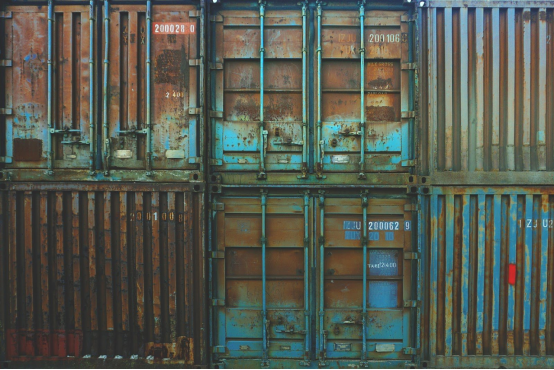
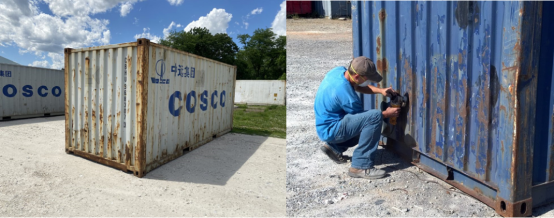
2. Correct Container Usage – Key to Reduce Damage
① Strictly Control Loading Weight
• Never exceed the MAX PAYLOAD marked on the container door.
• Overweight causes: floor breakage, bottom frame deformation, top beam fracture, safety risks.
② Evenly Distribute Load
• Avoid heavy loads concentrated on one end/side.
• Use wooden mats to disperse pressure for heavy machinery/steel coils.
③ Standard Forklift & Loading Operation
• Do not drag cargo directly on the floor.
• Reserve gaps: top \20mm, bottom \100mm.
• Use dunnage to protect floors and allow fork withdrawal.
④ Prevent Pollution & Leakage
• Liquid/pollution goods at the bottom; separate with plastic/canvas.
• Cover the floor to avoid permanent stains; floor replacement costs hundreds of dollars.
⑤ Secure Cargo Properly
• Use lashing materials to prevent shaking and collision during transit.
⑥ Reefer Container Special Rules
• Pre-cool goods properly; do not cool down inside the container.
• Keep vents unblocked; leave top gap for air circulation.
• No spoiled goods to avoid cross-contamination.
• Keep 220/380V power connected during transit.
• Report unit faults to depot/agent immediately.
⑦ Special Cargo Notice
Coiled steel, marble, scrap, logs, ore, sugar, starch, etc., require extra protection and comply with special handling rules.
3. Container Daily Maintenance & Repair Management
Daily Maintenance Tips
• Clean oil stains immediately to avoid floor penetration.
• Conduct routine inspections when entering depots.
• Repair small damages in time to avoid expansion.
Repair Management Rules
• Strictly prohibit unqualified repair workmanship.
• Do not use substandard repair materials.
• Choose certified repair stations.
Two International Repair Standards
• IICL Standard: High-standard, widely used by major leasing companies.
• CARGOWORTHY Standard: Cargo-worthy level, commonly used by shipping lines.
Operation Standardization
• Standardize agent operation processes.
• Certify and supervise users and depots.
• Establish complete inspection & record systems.
4. CIMC Equilink Container Supply & Service
CIMC Equilink provides new and used containers with professional repair guidance and after-sales support:
• Dry van containers
• Reefer containers
• Open-top containers
• Modified containers & custom solutions
We support global delivery and provide professional advice on container sales, repair, and transportation.
Contact Us
For container purchase, repair consultation, or quick quotation:
• Email: info.equilink@cimc.com
• Official website: Submit inquiries for fast response
CIMC Equilink – Your reliable partner for container sales, maintenance, and global logistics solutions.
Share:


Quick Quote
Contact UsHutai Road, No. 6415 Baoshan District, Shanghai China
Tel: +86 21 6686 7007
Fax: +86 21 6686 7007
Company Mobile: +86 17316368719
Email: info.equilink@cimc.com








 Copyright © 2019 CIMC Equilink
- Container Parts