
 中文
中文
-
Shipping Containers
- Container Parts
- Roof Panel
- Side Panel
- Front End Panel
- Door Panel
- Front Corner Post
- Rear Corner Post (Outer/Inner)
- Cross Member
- Bottom Side Rail
- Top Side Rail
- Door Sill
- Front Bottom Rail
- Top End Rail
- Door Header Upper/Lower
- Door Rail
- Floor Spacer
- Angle
- Top/Bottom End Rail
- Door Edge Member
- Door Sealing
- Door Frame Profile
- Door Lining
- Door Hardwares
- Door Gasket
- Side Panel/Lining
- T-Floor
- Roof Panel/Lining
- Cross Member
- Bottom Side Rail
- Top Side Rail
- Ledge PVC
- Kazoo Drain
- Auto Drain
- Alu Tube
- Auto Drain Center Part
- PVC Drain Pipe
- PVC Plugs f. Drain with Ring and Steel Wire
- Door Screw
- Door Screw Nut
- Door Screw Rubber
- Tapping Screw
- Stainless Blind Rivet
- Lashing Ring
- CSC Plate
- Welding Wire
- Tapping Screw Bit
- Vehicle Parts
- Ship Supplies
- 00. Provisions
- 11. Welfare Items
- 15. Cloth & Linen Products
- 17. Tableware & Galley Utensils
- 19. Clothing
- 21. Rope & Hawsers
- 23. Rigging Equipment & General Deck Items
- 27. Painting Equipment
- 31. Safety Protective Gear
- 33. Safety Equipment
- 35. Hose & Couplings
- 37. Nautical Equipment
- 39. Medicine
- 45. Petroleum Products
- 47. Stationery
- 49. Hardware
- 51. Brushes & Mats
- 55. Cleaning Material & Chemicals
- 59. Pneumatic & Electrical Tools
- 61. Hand Tools
- 63. Cutting Tools
- 65. Measuring Tools
- 69. Screws & Nuts
- 75. Valves & Cocks
- 77. Bearings
- 79. Electrical Equipment
- 81. Packing & Jointing
- 85. Welding Equipment
- 87. Machinery Equipment
- Vehicles
- Lashing Tools
- Logistics Tools
Container PartsContainer Ship Cargo Securing Devices – How to Use Lashing EquipmentMay 22,2026A container vessel experiences six degrees of movement at sea: surge, sway, heave, roll, pitch and yaw. Combined with hull bending, twisting and relative movement between hatch covers and cell guides, containers face constant shifting forces. Only a complete, well‑maintained lashing system can resist these loads and keep containers safely stowed.
Lashing failures often lead to containers falling overboard, cargo losses, insurance claims and navigation hazards. Understanding proper use, inspection and maintenance of lashing equipment is essential for deck officers, crew and stevedores.
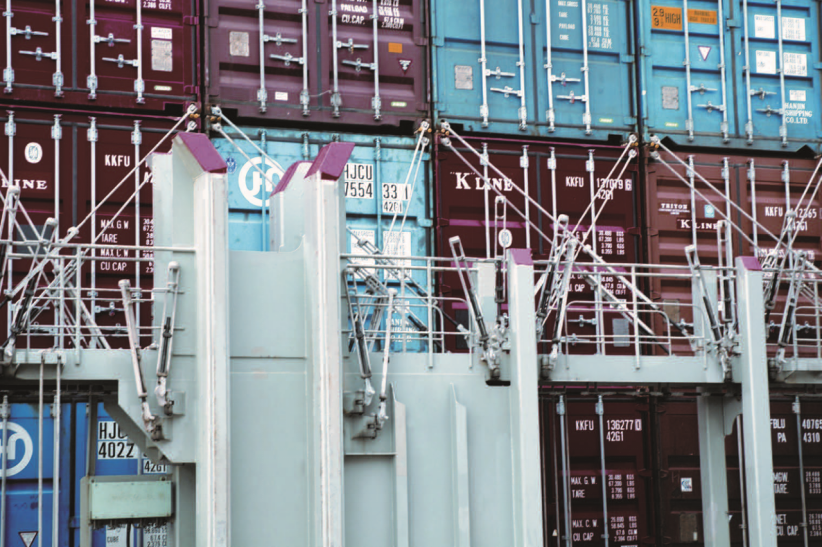
1. Overview of Container Securing System
Container securing equipment is divided into two categories:
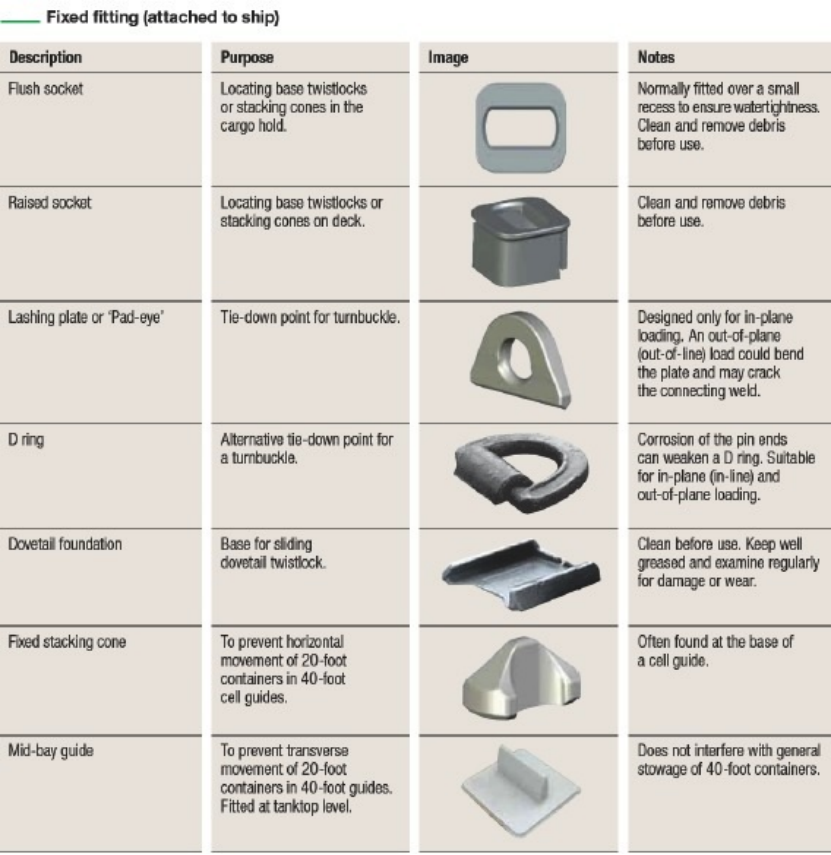
Fixed Securing Devices (Ship‑Installed)
• Flush socket
• Raised socket
• Lashing plate / pad‑eye
• D‑ring
• Dovetail foundation
• Fixed stacking cone
• Mid‑bay guide
These are integrated into the hull, deck or hatch covers and provide permanent securing points.
Portable Securing Devices (Movable)
• Twist lock (manual / semi‑automatic / full‑automatic)
• Stacker
• Bridge fitting
• Tension / pressure elements
• Lashing rod
• Turnbuckle
• Wrench tools
These are used during loading and unloading to connect and stabilize containers.
2. Key Lashing Equipment & Usage
Turnbuckle + Lashing Rod
• Used to secure containers of different heights with one rod length.
• Equipped with sliding nut for quick adjustment.
• Standard system: 50‑ton breaking load, rod diameter 26 mm.
Twist Lock
• Mechanical locking device for container corner castings.
• Manual: lever‑operated for bottom layer to deck.
• Semi‑automatic: auto‑lock under weight; manual release via cable.
• Full‑automatic: auto‑lock and auto‑unlock without handling.
D‑Ring
• D‑shaped lashing point welded to deck.
• Used with chains, straps and lashing assemblies.
• Standard MBL: 4t, 20t, 36t, 50t, 67t.
• Supports in‑plane and out‑of‑plane loading.
Fixed Fitting Functions
• Flush / raised socket: locating base for twist locks or stacking cones.
• Lashing plate / pad‑eye: tie‑down point for turnbuckle (in‑plane only).
• Dovetail foundation: base for sliding twist lock.
• Fixed stacking cone: prevents horizontal movement of 20’ containers in 40’ cell guides.
• Mid‑bay guide: prevents transverse movement in cell guides.
3. Inspection & Maintenance Rules
To ensure lashing reliability:
• Conduct regular visual inspections of all components.
• Lubricate moving parts and threaded connections.
• Repair or replace damaged, deformed or corroded parts immediately.
• Segregate and discard unqualified fittings.
• Keep sufficient portable equipment onboard as per the Cargo Securing Manual.
• Do not load cargo if lashing devices are insufficient or defective.
4. Safety Principles
• Lashing areas must be safe for crew and stevedores.
• Follow the ship’s Cargo Securing Manual for arrangement and quantity.
• Use correct devices for each container type and stack height.
• Never overload lashing points beyond rated capacity.
• Repair defects before departure to avoid container loss at sea.
CIMC Equilink – Full Range of Lashing Equipment
CIMC Equilink provides high‑quality container securing parts for global shipping:
• Twist locks (manual, semi‑automatic, full‑automatic)
• Lashing rods & turnbuckles
• D‑rings (various MBL)
• Bridge fittings, stacking cones
• Lashing plates, sockets, foundations
• Complete container lashing systems
All products meet marine standards for strength, durability and safety.
Contact Us
For inquiries about lashing equipment, pricing or catalogs:
• Email: info.equilink@cimc.com
• Website: www.cimc-equilink.com
We provide professional one‑stop solutions for container securing and marine accessories.
Share:


 Prev article: No Data Next article: Safety Guard – Container Twist Lock
Quick Quote
Contact UsHutai Road, No. 6415 Baoshan District, Shanghai China
Tel: +86 21 6686 7007
Fax: +86 21 6686 7007
Company Mobile: +86 17316368719
Email: info.equilink@cimc.com








 Copyright © 2019 CIMC Equilink
- Container Parts